

Unearthing Sustainable Solutions: A Journey Through Philippine Markets and Agricultural Innovations
- Jul 27, 2023
- 4 min read
Ready to get meetings set and interviews in action, the team had a productive morning, building on existing contacts and establishing new ones through Professor Erwin Lizarondo's assistance. New contacts included farm organizations and incubators offering valuable insights into current farming and agricultural waste practices.
Following up with previous contacts proved successful right away as Cayla and Estefania discussed packaging pricing and characteristics with Stephen from WTH Foods. They explored sustainability culture and challenges in marketing consciously-sourced plant-based products. In another meeting, they connected with Jun at BEECALL, a Filipino incubator, to learn about available startup resources like funding, mentorship, and partnerships. Additionally, Matt and Max spoke with Dr. Elmer Soriano, a friend of Professors Mehta and Lizarondo, who generously provided contact information for The Bamboo Impact Lab, a project focused on converting bamboo leaves into products.
To further their investigation of the current packaging market, Max, Sophia, and Matt visited a major packaging distributor, gathering information on eco-friendly and non-eco-friendly manufacturers. They noted brands and prices for the products, getting us information about the difference in eco-friendly and plastic pricing. The team also visited Mega Q Mart and Balintawak Market, two of the major markets in the area. The goals of visiting markets were to further assess the packaging used and to speak to farmers regarding their current waste practices. On the consumer packaging side, they found that a couple of companies seemed to dominate the market and that many stalls offered a small amount of eco-friendly packaging. The eco-friendly packaging was consistently more expensive and less popular than their plastic counterparts. Confusingly, they saw polystyrene (styrofoam) packaging being marketed as eco-friendly and sustainable, demonstrating that information regarding sustainability may be less widespread than they thought. At the markets, the team also talked to farmers about waste generation on their farms. Many of the farmers said that their waste was used as a fertilizer for the rest of their crops, or in the case of bananas, their trunks were used to construct crates to move produce. As the Mega Q market was closing down, the team noticed that lots of the spoiled or leftover produce was put into bags to be thrown away. The team inquired where the waste was going to but could not get a solid response. This leaves questions about the current organic waste management system and opens the door for this waste to be an input stream for packaging material if it was correctly sorted. At Balintawak Market, the team noticed that most of the corn was solid wholesale with the husk on, which leads to more questions about whether corn husks would be best sourced at the farms or at a different location like these markets.


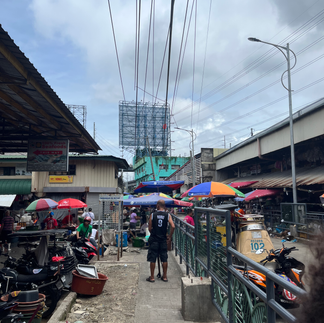


Balintawak market
To get a different perspective on agriculture, Max and Matt visited several Department of Agriculture buildings, those being the Bureau of Soils and Water Management, the Bureau of Agricultural Research, and the Department of Agriculture Secretary building. The Bureau of Soils and Water Management had useful information on composting, but their meeting there was brief. The Bureau of Agricultural Research provided contacts to other departments, but they stated that their bureau was mostly for funding, and they did no research in-house. The funding they give out could not go to a United States team, but they commonly fund students from UP Diliman, which could be a money source through our partnership with UPD.
The last stop in the Department of Agriculture sector was the Fiber Processing and Utilization Lab, which was recommended by the Department of Agriculture Secretary building. This lab has worked for years with the fibers of many types of plants commonly grown in the Philippines and has converted many of the fibers into paper. This lab greeted us warmly and was extremely knowledgeable in terms of procedural advice and expertise. Since the team is considering creating a cardboard-like material, the experts at the lab had advice about a process similar to one that the team is working to develop. The lab was kind enough to share a procedure with us on how to make paper out of many types of natural fibers, including corn husk and banana stalk. This procedure is a huge benefit as we no longer have to develop our own entire procedure; rather, we can edit a trusted one that has proven results. The experts highly recommended banana stalks because of the long, strong fibers and even gave us a demonstration of a decorticating machine on a fresh banana stalk, but this uncovered the fact that only 1% of the stalk is useful fiber. The experts also warned against using corn husk, stating that it was prone to warping and requires more effort, but the papermaking process that they have the most expertise in is different enough from developing a cardboard-like material that it certainly doesn't rule out husks as a usable resource. All of this information will be critical in our product development, though it leads to more questions regarding the agricultural input we should choose.


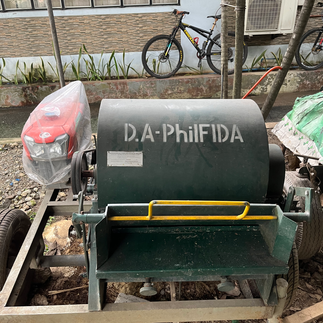
From left to right: Fiber Processing and Utilization Laboratory, Cellulose formed during the paper making process, and the decorticating machine
As we move forward, we will continue the approach of learning from a top-down and bottom-up approach simultaneously as they each give their own perspectives that are both crucial for designing a product that is successful in the long term. The trips and calls certainly helped us learn that connecting with organizations that are working in tangential fields can offer more opportunities to learn the ecosystem that our solution will have to thrive in.


Comments